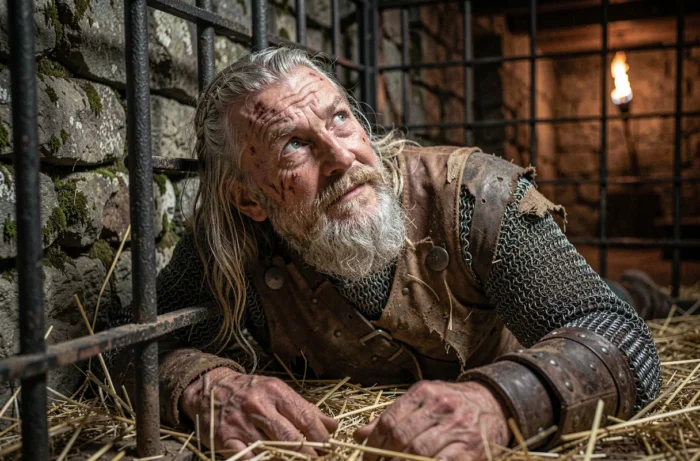
Ragnar Lothbrok dies in the series Vikings at the end of season 4, thrown into a pit of snakes by King Aelle of Northumbria. Before succumbing to the bites, the character created by Michael Hirst delivers a speech that has become iconic among fans. These last words blend defiance, prophecy, and acceptance of death, but their origin far exceeds the confines of the television series.
The Krákumál, the poem that inspired Ragnar’s last words
Most of the lines attributed to Ragnar Lothbrok at the moment of his death are not an invention of the series aired on History Channel. They find their roots in a Norse text called Krákumál, a funeral song composed several centuries after the supposed time of the character.
This poem presents itself as a monologue delivered by Ragnar himself from the pit of snakes. He reviews his past battles, recalls his fallen companions, and asserts his certainty of joining Valhalla.
The text is not limited to a single shocking phrase: it is a complete poetic ensemble, where death serves as a narrative framework for a life of raids and conquests. A detailed article discusses Ragnar’s death on Le Petit Castor by analyzing each significant line from this scene.
The most famous phrase from the Krákumál, often cited as Ragnar’s “last words,” roughly translates to: the little pigs would squeal if they knew what the old boar suffers. This image foreshadows the future revenge of his sons, notably Ivar, Björn, and Sigurd, against King Aelle.
Translation Variants and the Unstable Transmission of Ragnar’s Speech
A point rarely addressed by fans of the series: there is no single version of this line. Translations from Old Norse to modern languages produce different formulations, sometimes significantly distanced from each other.
Some sources render the metaphor as “the little pigs would squeal if they knew what the old boar suffers.” Others prefer “when the boar bleeds, the piglets come.” The meaning remains close (the offspring will avenge the father), but the tone changes. The first version emphasizes the suffering endured. The second highlights the inevitability of the retaliation.
This textual instability reminds us that the Krákumál was transmitted orally before being written down, probably in the 12th century. Each scribe, each translator introduced their own stylistic choices. Therefore, speaking of Ragnar’s “exact last words” amounts to freezing a text that, by nature, has never been fixed.
What Michael Hirst Kept and Modified for the Series Vikings
Showrunner Michael Hirst relied on the Krákumál to write Ragnar’s final speech in season 4, but he adapted it for television drama. In the series, Ragnar speaks directly to King Ecbert (with whom he has formed an ambiguous relationship) before being delivered to Aelle. His speech blends elements of the Norse poem with personal reflections on fate and the gods.
The line “I have chosen my own fate” does not appear in the Krákumál. It is an addition by Hirst that aligns with the character’s narrative arc throughout the seasons: a Ragnar who questions Norse religion, dialogues with Christianity through Ecbert, and refuses to submit to divine fatalism.
Ragnar Lothbrok, Legendary Figure or Historical Character
Before taking his last words at face value, one must ask a preliminary question: Did Ragnar actually exist? Modern scholars consider that Ragnar Lothbrok is a composite figure, constructed from several Viking leaders whose exploits have been merged by oral tradition and then by the sagas.
The main sources that mention Ragnar are:
- The Krákumál, a poetic funeral song composed long after the supposed events, which attributes to Ragnar a heroic monologue from the pit of snakes.
- The Saga of Ragnar with the Hairy Breeches (Ragnars saga loðbrókar), a 13th-century Icelandic prose narrative that recounts his adventures and death.
- The Gesta Danorum by Saxo Grammaticus, a 12th-century Danish chronicle that mentions a similar character without using exactly the same name.
None of these sources are contemporary with the events they describe. The available data does not allow us to conclude that a single individual named Ragnar Lothbrok uttered these words in a pit of snakes in Northumbria. The scene belongs to legendary narrative, not historical testimony.
The Prophecy of Ragnar’s Sons in the Series and in the Sagas
The true stakes of Ragnar’s last words, whether in the Krákumál or in Michael Hirst’s series, are not death itself. It is what comes after.
The metaphor of the boar and the piglets directly foreshadows the invasion of England by the Great Pagan Army, led according to the sagas by Ragnar’s sons, including Ivar the Boneless. In the series Vikings, this promise of vengeance structures the entire subsequent narrative after season 4. Ragnar’s death is not an end: it is a narrative trigger.
King Aelle, Ragnar’s executioner, suffers in the sagas as in the series the torture of the blood eagle, a form of ritual torture whose historical authenticity is still debated among scholars. Ecbert’s fate is different in the series, where the character chooses his own death, but the pattern remains the same: every king involved in Ragnar’s death pays the price foretold by the final speech.
The last moments of Ragnar Lothbrok function as a hinge, both in the narrative mechanics of the series and in the Norse literary tradition. His words do not document a verifiable historical fact. They serve a precise function: to transform a defeat (the capture, the pit, the death) into a foundational act of a coming vengeance. It is this inversion that has resonated with fans, far beyond the mere pleasure of the quote.