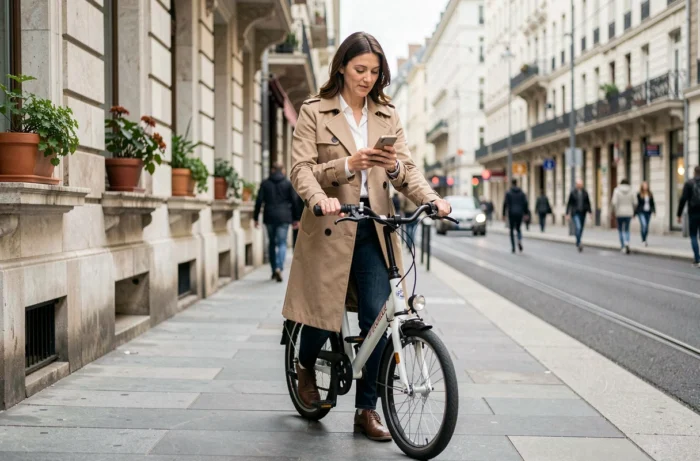
Choosing how to get around each day is no longer just about taking your car or the bus. Since January 1, 2025, urban areas with more than 150,000 inhabitants must implement a low emission zone (LEZ), with restrictions related to the Crit’Air sticker. The appropriate mode of transport now depends on the vehicle you own, your area, and your regular routes.
LEZ and Crit’Air sticker: the game-changing filter
Before comparing bike, carpooling, or public transport, you need to check one concrete point: is your current vehicle still allowed to circulate in your area? The rules of LEZs vary by community. A diesel classified as Crit’Air 4 may drive freely in a medium-sized city but could be banned in the neighboring metropolis.
This regulatory constraint is pushing many drivers to rethink their transport combination rather than simply changing cars. In practice, this sometimes means using the train or coach to enter the LEZ, and then a folding bike or scooter for the last mile. You can access declicauto.fr for transport to evaluate vehicle options compatible with these restrictions.
The key takeaway: the LEZ does not eliminate the car, it redistributes usage. A single household can keep a vehicle for suburban trips while adopting a softer mode for intra-metropolitan travel.

Biking daily: beyond the enthusiasm, the real obstacles
Biking is gaining significant traction in dense urban areas. Have you noticed that some bike paths abruptly stop, forcing you to ride on a road shared with cars? This discontinuity in infrastructure remains the main barrier to adopting biking as a daily mode of transport.
Two conditions determine whether biking can truly replace the car for a home-to-work trip:
- The continuity of the bike route between the starting point and the destination, without breaks on high-traffic roads
- The availability of secure bike parking at the destination, ideally covered and immediately near the workplace
- The actual distance of the trip: beyond 10 km, a traditional bike becomes cumbersome without electric assistance
On the financial side, a recent change deserves attention. National subsidies for purchasing a bike (ecological bonus and conversion premium) ended on February 14, 2025. However, repairs are still eligible for the Repair Bonus scheme. The initial investment now relies on personal budget or potential local aids.
Electric bike or muscle bike: which choice for which trip
An electric bike eliminates elevation changes and extends the range. For a hilly 8 km trip, it transforms a daunting effort into a comfortable twenty-minute journey. The muscle bike remains appealing on flat and short routes, with significantly lower maintenance costs.
The decision criterion is not the price of the bike, but the regularity of use. An electric bike used five days a week costs less per trip than a car parked half the time.
Carpooling for home-to-work: what really works
Carpooling for regular trips has changed face thanks to dedicated apps that facilitate connections between drivers and passengers sharing the same routes.
Daily carpooling relies on recurrence, not goodwill. When two people share the same time slot and route five days a week, the organizational burden disappears after the first week.
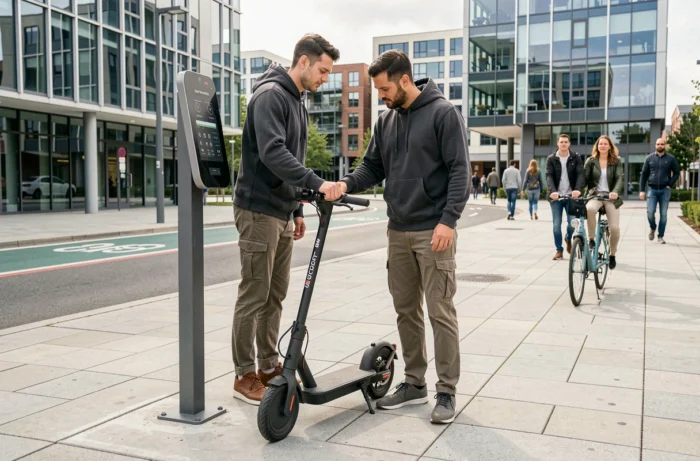
Carpooling has a clear advantage in suburban areas, where public transport is infrequent. For a 25 km trip without a nearby train station, it often constitutes the only realistic alternative to solo driving.
Mobility apps: environmental information becomes mandatory
Digital services for travel assistance must now utilize open transport data and present the environmental impacts of routes. In practice, when you search for a trip on an app, it must allow you to rank options according to greenhouse gas emissions.
This is not a gimmick. This requirement changes how alternatives appear on the screen. A solo car trip that seemed the fastest ends up at the bottom of the list if the environmental criterion is activated. The train or carpooling moves up automatically.
Combining modes through open data
The real advancement of these apps lies in intermodality. A single trip can combine bus, bike-sharing, and walking, with a total time sometimes comparable to that of driving during peak hours. The actual time savings depend on the smoothness of connections, not the speed of a single mode.
For rural and suburban areas, the offer of public transport remains fragile. The return to pre-health crisis attendance is not enough to ensure schedules suited to shift workers. In these territories, the combination of carpooling and biking remains the most flexible solution.
Adapting your daily travel does not require changing everything at once. Testing an alternative mode on just one trip per week is enough to measure the real constraints. The best indicator is not the theoretical carbon footprint, but the trip you are willing to take again tomorrow morning.