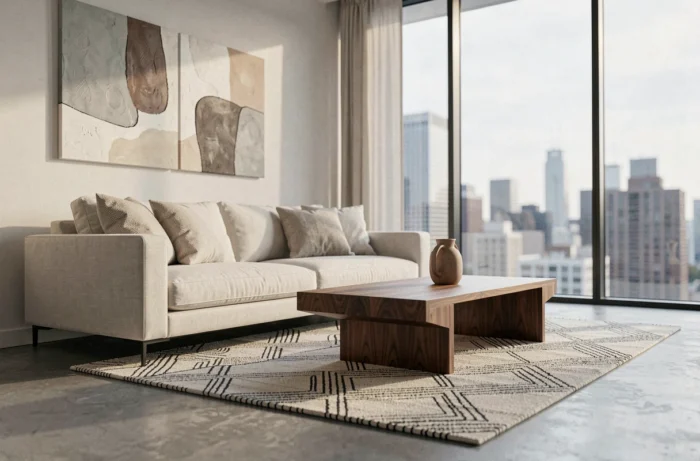
Transforming an interior is not just about choosing a color palette or replacing a sofa. Even before discussing style, air quality and the materials used determine the real comfort of a space. This article measures the gap between the most common decorative gestures and those that produce a lasting change in the atmosphere of a room.
Decorative materials and indoor air quality: an angle too often overlooked
Classic decorating advice focuses on shades, textures, and furniture arrangement. It rarely addresses chemistry. The French label on volatile organic compound (VOC) emissions concerns paints, adhesives, and flooring, but does not cover furniture uniformly.
A new particle board piece can emit formaldehyde for several weeks after installation. Choosing a finish for its elegance without checking its emission class is akin to decorating a space with deteriorating air quality.
Before any transformation project, checking and maintaining the ventilation system remains a prerequisite that style guides often ignore. For new homes subject to RE2020, verifying ventilation upon receipt is mandatory for building permits submitted since January 1, 2022. In older homes, a simple check of extraction vents and air intakes can make a significant difference.
Second-hand accent pieces, which have long been off-gassed, reduce this risk while adding character to the decor. Several resources exist to combine aesthetics and housing health, and Monsieur Magazine’s home site regularly details these trade-offs between style and healthy living.
Colors and lighting in the living room: what a comparison of approaches shows
The color-light combination determines the perception of a space more than any piece of furniture. The table below contrasts two common strategies for a standard-sized living room.
| Criterion | Neutral monochrome approach | Targeted accent color approach |
|---|---|---|
| Wall palette | Off-white or light gray on all walls | Bold hue on one wall, neutrals elsewhere |
| Number of light sources | Single ceiling light | At least three points (pendant, reading lamp, indirect lighting) |
| Perceived effect on volume | Bright but flat space, little depth | Enhanced depth, the gaze is guided |
| Main risk | Aseptic atmosphere, personality-less living room | Saturation if the hue is too bright or the wall poorly chosen |
| Relative budget | Low (one pot of paint, one light fixture) | Moderate (additional paint, two accent lights) |
The budget gap remains limited. Three diversified light sources (pendant, floor lamp, string lights or LED strip behind a piece of furniture) are enough to create a mood that can be adjusted according to the time of day.
Choosing the accent wall without making a mistake
The colored wall works best on the wall that the eye meets upon entering the room. A side wall or a wall partially obscured by a tall piece of furniture dilutes the effect. The hue should interact with the existing textiles (cushions, curtains, rugs) to avoid a visual break.
Structuring furniture versus accent pieces: where to invest for a modern interior
The classic temptation is to renew all the furniture. The clearest results come from a more targeted compromise.
- Structuring furniture (sofa, dining table, bed) defines the proportions and circulation in the room. They deserve an investment in appropriate dimensions and durable materials, chosen new to control the exact measurements.
- Accent pieces (end table, corner chair, entry console, mirror) add character. Reuse or second-hand options offer an advantage here: patinated finishes, shapes no longer found in stores, and VOC emissions that have already dissipated.
- Textiles (curtains, throws, cushion covers) represent the quickest and least expensive transformation lever. Changing the material of a curtain, moving from fine polyester to thick linen, alters the perception of the living room without touching the furniture.
This hierarchy avoids dispersing the budget. A well-sized sofa, complemented by a thrifted chair and renewed textiles, produces a more coherent result than a complete renewal at the entry level.
Integrated storage and circulation: the invisible square meters
The elegance of an interior depends as much on what is visible as on what is not. A cluttered living room appears smaller regardless of its actual size. The difference lies in the ratio between closed storage space and cleared floor area.
Prioritizing closed storage (buffets, low cabinets with doors, integrated niches) rather than open shelves reduces visual load. An open shelf exposes every object to view and requires constant staging effort.
Clearing the center of the room
Pulling the sofa away from the wall by a few dozen centimeters creates a circulation corridor behind and gives an impression of volume. This gesture, often cited in decorating guides, works best in rooms where the width significantly exceeds that of the sofa. In a narrow space, the opposite effect occurs: the central passage shrinks, and the room seems cluttered.
The most reliable test remains actual circulation. If two people can pass each other without brushing against each other between the sofa and the coffee table, the proportions are good.
An elegant and modern interior relies less on the accumulation of trends than on measured choices: verified ventilation, controlled materials, diversified lighting, closed storage. These four axes, applied in this order, transform a living space more sustainably than a simple change of palette.