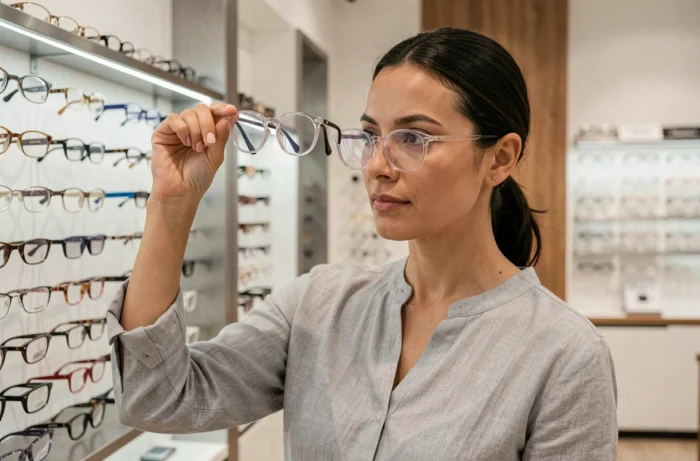
Prescription glasses are medical devices. Their issuance is based on a precise regulatory framework, centered around the ophthalmological prescription. Buying a corrective pair in France usually requires presenting a valid prescription to an optician. However, the question often arises: can this step be bypassed, and if so, under what conditions?
Validity of the ophthalmological prescription and adaptation by the optician
The starting point for any acquisition of corrective glasses remains the prescription issued by an ophthalmologist. Its validity period varies according to the age of the wearer: less than one year for those under 16, up to five years between 16 and 42, and three years for those over 42.
As long as this prescription is valid, the optician can renew the equipment without a new medical consultation. They even have the option to adjust the correction in case of slight changes in vision (presbyopia, astigmatism, myopia). The ophthalmologist is then informed of the modification made.
Many people who think they want to obtain glasses without a prescription actually have a still-valid prescription without realizing it. Checking the date on the document is sometimes enough to resolve the situation without an additional medical appointment.

Glasses without any prescription: what the regulations actually allow
It is important to distinguish between two very different situations. The first concerns non-corrective glasses: sunglasses, reading glasses with non-corrective lenses, blue light blocking glasses with neutral lenses. No prescription is needed to purchase them, whether in-store or online.
The second situation concerns corrective lenses. Without a valid prescription, an optician is not allowed to issue reimbursable corrective optical equipment. This is not a matter of goodwill; it is a legal framework.
Exceptions in case of emergency
Certain scenarios allow the optician to provide equipment without a valid prescription. Typically, if a pair of glasses is broken and the wearer cannot wait for an appointment, the optician can perform a temporary fix based on the previous prescription. This practice is regulated and does not always lead to reimbursement by Health Insurance.
The ophthalmologist may also indicate on the prescription a prohibition on adaptation by the optician. In this case, no renewal is possible without a new consultation, regardless of the date on the document.
Teleconsultation in ophthalmology: a quick but not nonexistent prescription
Teleconsultation does not eliminate the need for a prescription; it speeds up its acquisition. For several years, platforms have allowed patients to consult an ophthalmologist remotely. The practitioner can conduct a visual examination via connected tools and issue an electronic prescription.
This process is particularly beneficial for patients in areas where appointment wait times can reach several months. Teleconsultation produces a legal prescription identical to one issued in an office. The optician can then prepare the equipment as usual.
The key nuance to remember: teleconsultation remains a medical consultation. It does not allow one to bypass the prescription, but it significantly shortens the time between the need and obtaining glasses.

Reimbursement for glasses and periodicity of coverage
Having a valid prescription does not automatically guarantee reimbursement. Coverage by Health Insurance follows its own periodicity: an adult is generally reimbursed every two years, with early renewal possible if vision has changed.
This gap between the validity of the prescription and the reimbursement window creates frustrating situations. A 35-year-old patient may have a prescription valid for another four years but may not be eligible for reimbursement if they changed glasses the previous year.
The 100% Health basket in optics
The 100% Health scheme offers a zero out-of-pocket cost provided one chooses basket A and has a responsible mutual insurance contract. Basket A offers a selection of frames and lenses with capped prices.
- The lenses in basket A cover common corrections (single vision and progressive) with included treatments (anti-reflective, scratch-resistant)
- The frames in basket A are offered at a capped price, with a selection that has expanded in recent years
- Basket B (free pricing) allows for more aesthetic choices but involves variable out-of-pocket costs depending on the mutual insurance
To benefit from 100% Health, a prescription is still necessary. No reimbursement, even partial, is possible without a medical document.
Special case of first glasses
A person who has never worn glasses does not have any prescription to renew. The first pair of corrective glasses always requires a complete ophthalmological consultation, either in-office or via teleconsultation. No optician can provide initial equipment without a prescription.
The vision tests offered in optical stores do not replace this initial consultation. They are only meant to verify or refine an already prescribed correction.
The short answer to the posed question is summed up in one sentence: obtaining corrective glasses without any prescription is not legally possible in France for reimbursable equipment. The realistic lever remains to check the validity of one’s last prescription, have it adapted by an optician, or resort to teleconsultation to obtain a prescription without waiting several months.