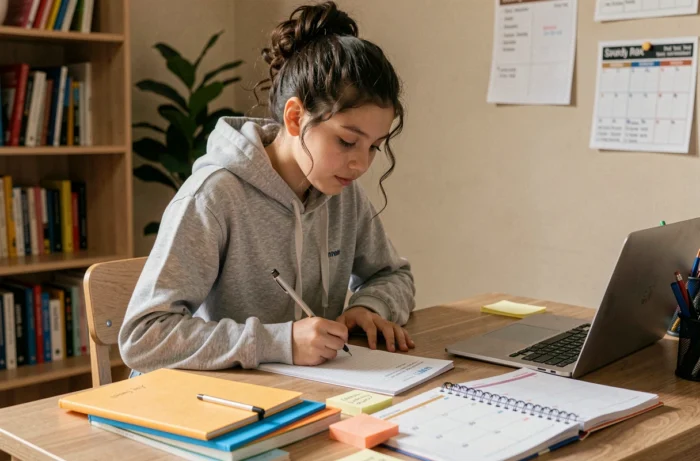
The second year of high school involves close to thirty hours of classes a week, plus periods with no lessons that aren’t identified on the timetable. The key to finding balance isn’t trying to “get better organized,” but learning to turn these dead periods into productive time while protecting sleep and managing cognitive load.
Free periods in the second year of high school: turning wasted time into productive work
A report published by the Inspectorate General in July 2023 describes school days that sometimes include several hours without classes, with transport constraints forcing some students to stay at school from opening to closing time. This creates a gap between the free time shown on paper and the unwanted waiting time with no clear purpose.
Students who manage to keep their grades steady distinguish between two types of free periods. The first, immediately after a demanding class (science or mathematics), is for reviewing notes while working memory still retains the structure of the lesson. The second, at the end of the day or before a transport slot, is better suited to routine tasks such as practice exercises and vocabulary flashcards.
At several European high schools, including in Denmark and the United Kingdom, these periods are formally scheduled as study periods built into the timetable. In France, library capacity is often limited, so students end up spending these periods in places that aren’t conducive to concentration. Finding a quiet spot (a little-used study hall or a corner of the media library) before the school year starts can make a real difference.
Several students who have managed to optimize their second-year high school timetable report that simply assigning a specific task to each free period on Sunday evening has significantly reduced their workload at home.
Spreading schoolwork across the week: the Sunday-night trap
Putting off homework and revision until the weekend is the most common habit at the start of the second year of high school—and the most counterproductive. The cognitive load built up over five days of classes can’t be made up for with two three-hour sessions on Saturday and Sunday.
Breaking revision into short daily sessions produces better results than two long blocks at the end of the week. A focused 20- to 30-minute session on a single subject after getting home is enough to reinforce what was covered that day.
The second-year high school timetable often includes new subjects (economics and social sciences, digital sciences and technology) whose conventions students aren’t yet familiar with. Those who do well set aside a regular slot early in the week for these subjects instead of putting them off in favor of subjects they already know well.
A weekly schedule that takes fatigue into account
Monday and Tuesday are generally the heaviest days for lectures. Doing math or physics and chemistry exercises on those evenings means working when you’re at your most tired.
- Monday and Tuesday evenings: actively review the day’s lessons (highlighting, rephrasing in the margins); avoid lengthy written assignments.
- Wednesday afternoon: the main study block, for homework and exercises that require careful thought.
- Thursday and Friday: focused revision for the next day’s subjects, in sessions of no more than 20 minutes.
- Weekend: one structured session on Saturday morning to prepare for the week ahead; keep the rest of your free time free.
This schedule isn’t rigid. The goal is to spread the workload over five days rather than cramming it into two.
Sleep and screens in the second year of high school: two factors that matter more than study methods
Surveys by Santé publique France show that young people’s relationship with screens is more nuanced than the usual advice to “switch off in the evening.” Passive use (aimless scrolling) and active use (research or school-related communication) don’t have the same effect on falling asleep or sleep quality.
A second-year high school student who finishes homework at 9 p.m. and then spends 45 minutes passively scrolling through social media delays their bedtime without gaining anything from it. By contrast, a quick exchange in a class group chat to clarify a lesson can be useful, as long as it stays brief.
Setting a screen curfew rather than banning screens is the most realistic strategy. Students who describe a sustainable balance don’t give up screens; they set aside a limited amount of time for them, just as they do for any other daily activity.
Sleep and your timetable: counting backward
Start with the wake-up time required for your first class and count back eight hours to find your target bedtime. If your first class is at 8 a.m. and your commute takes 30 minutes, you’ll need to get up at 7 a.m., which means ideally going to bed by 11 p.m. Anything that eats into that time (late homework, screens, evening sports) adds to your sleep debt over the course of the week.

Extracurricular activities and workload in the second year of high school: finding the right balance
Giving up all sports or creative activities to “focus on schoolwork” is a common mistake. High school students’ mental health is an important indicator of balance, beyond grades alone. Students who keep up a regular activity report managing stress better and staying more focused in class.
The tipping point usually comes when extracurricular activities exceed three sessions a week. Below that, they help students recharge. Above it, they compete directly with time for independent study and sleep.
- Keep a physical or creative activity, even if it’s just one session a week, to support your mental well-being.
- Avoid scheduling activities on the evenings of the busiest school days (often Monday or Tuesday).
- Review your activity load each term based on your actual school workload, not what you expect it to be.
Finding balance in the second year of high school doesn’t depend on a miracle method, but on practical choices: assigning a task to each free period, spreading work across the week, protecting sleep by setting a screen curfew, and keeping at least one non-school activity without feeling guilty. Tested week after week, these adjustments eventually create a steady routine that’s more reliable than any theoretical schedule.