
The pictograms printed on the control panel of a washing machine and on textile labels follow a standardized system. The international standard ISO 3758, revised in December 2023, establishes five families of care symbols (washing, bleaching, drying, ironing, professional cleaning) and specifies that each pictogram indicates the most severe treatment still allowed, not a recommendation. Knowing how to read these symbols prevents errors in temperature, cycle, or detergent product on a daily basis.
Reading order of textile care symbols
Before looking at an isolated pictogram, it is essential to understand the sequence. The 2023 revision of the ISO 3758 standard clarified a structural point: the symbols must always appear in the same order on a garment’s label.
- Tub (washing) in first position, with a number indicating the maximum temperature tolerated by the textile.
- Triangle (bleaching) in second position: empty for any agent, crossed with two diagonal lines for oxygen only, crossed with a cross for total prohibition.
- Square (drying), then iron (ironing), then circle (professional cleaning) complete the series.
Knowing this order allows for immediate identification of the sought information without scanning the entire label. It is a quick reflex to acquire that simplifies the management of dirty laundry before each wash.
To delve deeper into reading washing machine symbols for laundry, the correspondence between label and detergent drawer deserves a detour.
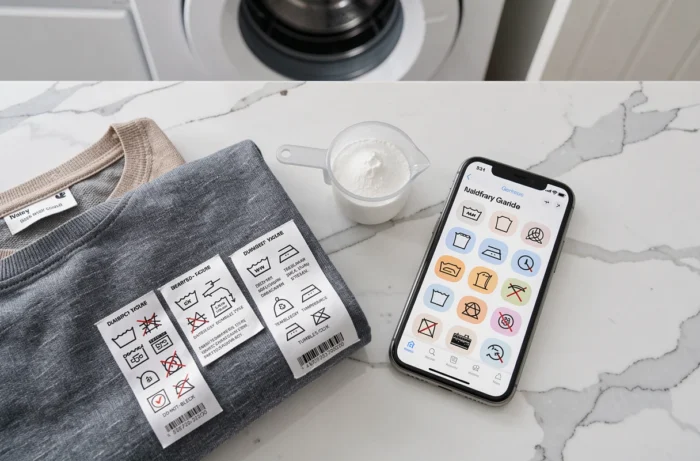
Washing temperature symbols on the washing machine panel
The pictogram of the tub filled with water is the one encountered most often, both on the garment label and on the machine’s program selector. The number inside the tub corresponds to the maximum temperature in degrees Celsius.
Tub and number: the limit, not the instruction
A textile marked with a tub at 40 °C can withstand washing at 30 °C or cold without issue. Washing below the limit preserves fibers and colors. Exceeding the indicated temperature risks causing shrinkage or irreversible discoloration.
A horizontal line under the tub indicates a delicate cycle (reduced spin, moderate agitation). Two superimposed lines indicate a very delicate program, suitable for fragile textiles. A hand drawn in the tub means that hand washing is preferable, even if some machines offer a dedicated program that mimics this gentle movement.
Tub crossed: machine washing prohibited
A cross on the tub strictly prohibits machine washing. This symbol concerns certain leathers, untreated silks, or structured pieces (lined jackets, for example). Ignoring this pictogram can distort the garment in a single cycle.
Common programs and their pictograms on the machine
The symbols on the control panel vary from one manufacturer to another, but a few icons are common across most devices.
The cotton ball indicates the cotton program, the most versatile. The drum spins fast, the spin is powerful, and the temperature range goes from cold to very hot. It is the most common cycle for everyday laundry (t-shirts, pants, sheets).
The wool ball signals a wool program: little water, slow rotation, minimal spin. Not all wool sweaters can withstand the machine, hence the importance of checking the label before starting this cycle.
The feather symbol (or snowflake, depending on the brands) corresponds to the delicate or synthetic program. It reduces drum speed and temperature to protect sensitive fibers.

Detergent drawer: identifying compartments using symbols
The washing machine drawer generally has three compartments, each marked by a symbol or a Roman numeral.
- The compartment marked II receives detergent for the main cycle (regular laundry).
- The compartment marked I receives pre-wash detergent, useful only for very dirty laundry.
- The compartment marked with a pictogram in the shape of a clover or flower receives fabric softener, released during the final rinse.
Pouring detergent into the wrong compartment can dilute the product at the wrong time in the cycle. A softener placed in compartment II, for example, will be drained before the final rinse and will have no effect on the softness of the laundry.
Drying and ironing symbols: completing the reading of the label
The square with a circle inside represents machine drying. A dot inside the circle allows for low-temperature drying, two dots indicate normal drying. A crossed square prohibits tumble drying.
The iron operates on the same principle of dots: one dot for a low temperature (synthetics), two for a medium temperature (wool, silk), three for a high temperature (cotton, linen). A crossed iron prohibits ironing.
These two families of symbols are often overlooked in favor of the washing pictogram alone. Reading the complete sequence (tub, triangle, square, iron, circle) takes a few seconds and prevents damaging a properly washed textile through inappropriate drying or ironing.
The system standardized by the ISO 3758 standard covers the entire maintenance journey of a textile, from the detergent drawer to the iron. Remembering the order of the five pictograms and the principle of the maximum limit is sufficient to handle the vast majority of situations encountered daily.