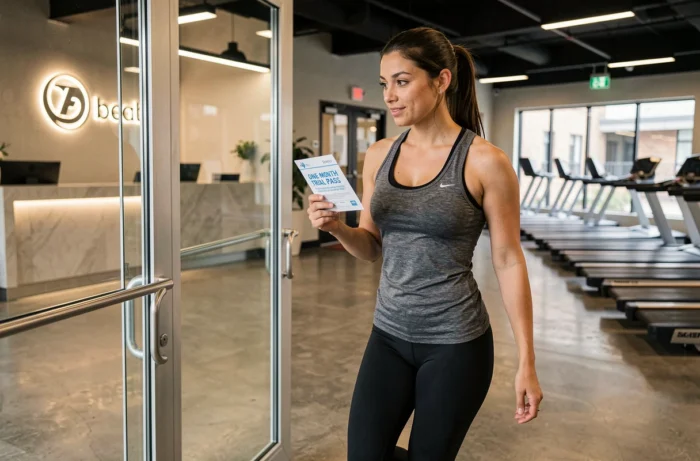
We arrive at a gym on a Monday evening, bag on shoulder, not quite sure if the equipment meets our needs, if the hours fit our schedule, or if the atmosphere suits us. Testing for a month without commitment is the only way to decide before committing for the long term. However, we need to know what we are really evaluating during these four weeks.
What a free trial session at the gym reveals (or not)
Most gyms offer a free trial session. We tour the facilities, try out a couple of machines, and leave with a flyer. The problem is that a single session tells us almost nothing about the actual quality of the club.
On a Tuesday at 2 PM, the gym is empty. On a Thursday at 6:30 PM, the bench press stations are occupied for forty minutes. Peak hour attendance changes everything, and a one-time visit does not allow us to measure it.
Cleanliness also varies. The showers can be spotless in the morning and in questionable condition by the end of the day. Air circulation, ambient noise, locker availability: all of this can only be assessed over multiple visits, not just one.
This is why the option of a gym membership for 1 month without commitment makes perfect sense. Four weeks allow us to test morning, evening, and weekend slots, and to see if the club keeps its promises on a daily basis.

No-commitment subscription: hidden fees to check before signing
A month without commitment does not mean a month without additional fees. Several gyms charge registration fees or membership card fees, even for a short-term plan. We’re often talking about a few dozen euros in addition to the advertised monthly rate.
Specifically, here are the items to examine before confirming payment:
- Registration fees (sometimes called “administrative fees” or “entry fees”), which are non-refundable if we do not continue the subscription.
- The membership card, charged separately at some gyms like Magic Form or Fitness Park, which adds to the price of the first four weeks.
- Automatic renewal: if the subscription automatically renews after the first month, we need to anticipate cancellation before the renewal date.
On this last point, regulations have changed. Since June 2023, any subscription taken out online must be able to be canceled online, free of charge and without registered mail. This is mandated by Article L.215-1-1 of the Consumer Code. In practice, we look for a cancellation button or form in the client area of the gym’s website.
Common contractual anomalies in fitness clubs
A survey by the DGCCRF conducted on the gym sector found that more than 70% of the establishments inspected had at least one anomaly. Nearly 39% of these irregularities concerned a lack of information about prices or general conditions.
We’re not talking about massive fraud, but rather a lack of transparency regarding cancellation conditions, price increases, or notice periods. Reading the general terms and conditions before signing up for a trial month remains the best protection.

Evaluation grid for a one-month gym test
A month is enough to form a solid opinion, provided we know what to observe. We don’t test a gym like we test a restaurant. The challenge is to project a regular practice over several months.
Equipment and available space
The number of machines matters less than their condition and variety. A gym with fifteen treadmills but only one squat rack will not suit someone looking to progress in weight training. Checking the availability of equipment during training hours remains the most reliable criterion.
The free space for floor exercises or stretching also deserves attention. Some low-cost gyms optimize every square meter at the expense of functional areas.
Group classes and mobile app
If group classes are part of the program, we check the actual schedule (not the one on the website, which may be outdated). Some gyms advertise yoga or boxing classes that only occur once a week, or not at all when the coach is absent.
Regarding the app, most premium gyms offer progress tracking, training videos, or slot reservations. Feedback varies on this point: some apps work well, while others are empty shells updated once a year.
Hygiene and maintenance
We observe the restrooms, water fountains, and the cleaning of machines between users. A good indicator: the visible presence of disinfectant spray and paper at each station. If this is not the case from the first week, it will not improve in the second month.
Proximity of the club and consistency: the true factor for success
You might find the perfect gym twenty minutes away. If the commute becomes a burden after two weeks, motivation collapses and the subscription becomes a ghost charge. The geographical factor weighs more heavily than the quality of the equipment over time.
During the trial month, we time the actual commute (not the Google Maps estimate on a Sunday morning). We test the parking or transport access, and evaluate whether the detour after work remains acceptable as fatigue accumulates.
- Less than ten minutes of travel: consistency is almost guaranteed if the gym is suitable.
- Between ten and twenty minutes: it works if the time slot fits into a fixed routine.
- More than twenty minutes: attendance drops significantly after the first month, especially in winter.
A month without commitment serves precisely to measure this. Not just the quality of the club, but its compatibility with our real lifestyle. The best subscription is the one we use three times a week for six months, not the one we pay for twelve months while going twice.