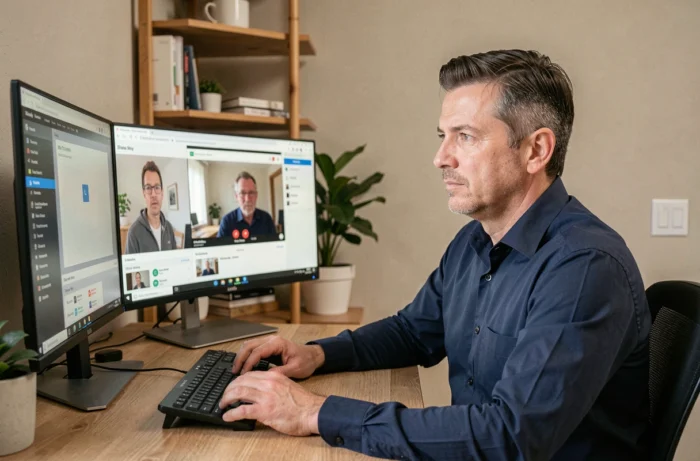
IT support covers a wide range: hardware troubleshooting, software configuration, remote assistance, preventive maintenance, or training. For an individual facing a blue screen and for an SME managing a fleet of workstations, the needs differ, but the principle remains the same. Finding the right solution requires distinguishing between what falls under occasional support, permanent software tools, and the tax framework governing these services.
Home IT Assistance and Tax Framework in 2024-2025
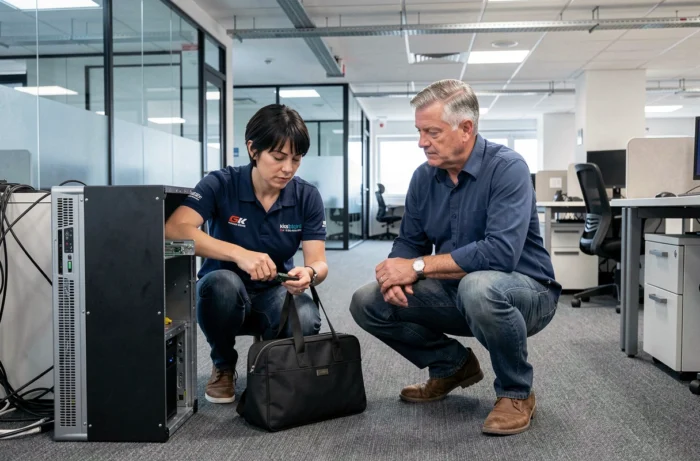
The intervention of a technician at home remains the most direct solution for individuals. Troubleshooting, peripheral installation, data recovery, software initiation: these services fall within the scope of personal services as defined by Article L.7231-1 of the Labor Code.
The often misunderstood point concerns tax eligibility. Home IT assistance entitles you to a tax credit of 50% of the expenses incurred, provided that the service provider is registered. The official tax base, updated in August 2026, confirms this eligibility under Article D.7231-1, II-11°.
A notable change occurred with the finance law for 2024 (Article 34): starting January 1, 2025, micro-entrepreneurs and companies with fewer than 11 employees benefit from an exemption from exclusive activity to operate in personal services. In practical terms, a technician who also offers cybersecurity consulting or hardware sales can now maintain their SAP approval without compartmentalizing their activities.
For those seeking IT assistance on SOS Technologies, this type of versatile provider covers both hardware troubleshooting and software support, with the possibility of benefiting from the tax credit if the conditions are met.
Helpdesk and Ticket Management Software for Professionals
On the business side, the need shifts towards structured management of requests. A helpdesk refers to a centralized system that receives, classifies, and tracks IT incidents until their resolution. The principle is based on the notion of a ticket: each request generates a unique identifier, assigned to a technician, with a complete history of exchanges.
Several categories of software coexist in the market:
- Generalist solutions like Zendesk or Freshdesk, which combine ticket management, knowledge base, and client portal. They cater to both internal IT teams and customer support services.
- ITSM-oriented tools (IT Service Management) like InvGate Service Management, which integrate approval workflows, a service catalog, and performance reports aligned with ITIL best practices.
- Lightweight or open-source helpdesks, suitable for structures with fewer than ten technicians, offering ticket management without the complexity of an enterprise tool.
The choice depends less on the number of features than on the size of the team and the volume of tickets processed. An SME with three people in support does not need a tool that manages multi-level SLAs.
Automation and AI in IT Support
The integration of artificial intelligence in helpdesks alters the distribution of work between the technician and the machine. Two mechanisms currently dominate.
The first is automatic ticket sorting. A language model analyzes the content of the request, assigns it a category (network, workstation, business software), and a priority level. The technician receives a pre-qualified ticket, reducing the initial processing time.
The second is response suggestion. Based on an existing knowledge base, AI proposes a draft response or a link to a resolution article to the technician. The gain is measurable on recurring incidents (password reset, VPN configuration, blocked update).
Automation does not eliminate the need for qualified technicians, but it shifts their intervention towards complex incidents. Level 1 requests, repetitive and well-documented, are where AI adds the most value.

Criteria for Choosing Between External Assistance and Internal Tools
The question is not always “which software to choose” but “do we need software or a service provider”. For an individual, the answer is almost always the service provider: a helpdesk tool makes no sense for domestic use. For a business, the line is blurrier.
Three criteria help make the decision:
- The recurrence of incidents. Fewer than five requests per week: an external provider or maintenance contract is sufficient. Beyond that, a tracking tool becomes cost-effective.
- The presence of a dedicated IT team. Without an internal technician, a ticket software remains an empty shell. The tool does not replace expertise.
- The need for traceability. In certain sectors (healthcare, finance), every intervention must be documented and archived. A helpdesk with a timestamped history meets this regulatory requirement.
The Pitfall of Over-Equipping
A common mistake is to deploy a complete ITSM tool for a team of two people. Unused functions clutter the interface, extend training, and ultimately discourage adoption. It is better to have a simple tool that is mastered than a comprehensive platform that is ignored.
The B2B SaaS market in France is undergoing a consolidation phase, with publishers combining helpdesk, asset management, and monitoring in the same suite. This convergence simplifies administration for large structures but complicates the choice for small teams that only need one component.
The best IT assistance solution in 2024 is not the most comprehensive on paper. It is the one that corresponds to the actual volume of requests, the size of the team handling them, and the framework (tax or regulatory) in which it operates.