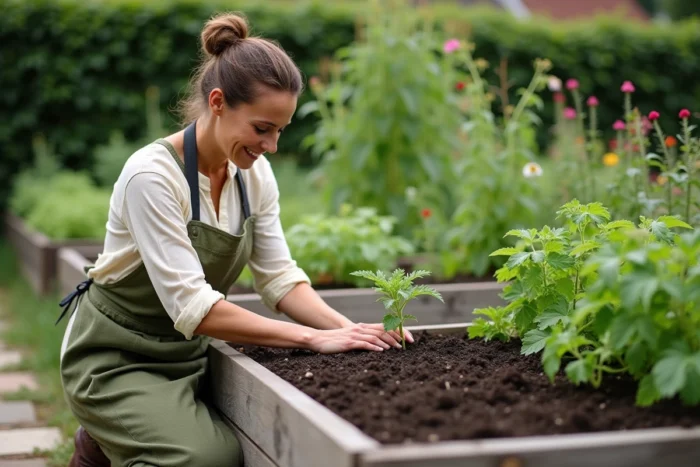
A productive organic vegetable garden all year round relies on a principle often underestimated: the continuity of crop cycles. Harvesting in January as well as in July requires planning each bed according to the seasons, but also understanding how the soil, plant associations, and water management interact over twelve months.
The organic vegetable garden is not just about banning chemical products. It is a system where every decision regarding sowing, rotation, or soil cover conditions the next harvest.
Regulation of organic inputs: what the European regulation changes for gardeners
Nettle ferments, horsetail decoctions, and other homemade preparations are part of the classic toolkit of the organic vegetable garden. Since the full application of Regulation (EU) 2019/1009 on fertilizing products, the marketing of these preparations is regulated as soon as they are resold as “fertilizing product” or “biostimulant”.
In practice, this means that garden centers have gradually removed certain ready-to-use products from their shelves between 2022 and 2024. For the amateur gardener, the consequence is direct: making one’s own ferments and macerations becomes the most reliable solution to have natural fertilizers compliant with an organic approach.
This regulatory framework does not concern personal use in the garden, but it limits access to commercial formulations. Preparing a comfrey ferment or a garlic decoction remains perfectly legal in one’s own vegetable garden, and the resources available on the Le Jardin de Gaïa website detail these recipes suited for organic vegetable crops.
Crop rotation and plant associations in the organic vegetable garden
Crop rotation involves not replanting the same family of vegetables in the same spot two years in a row. The principle is simple, but its effects are profound: it breaks the cycles of pests, limits the depletion of specific nutrients in the soil, and reduces the pressure from fungal diseases without any treatment.
A classic rotation scheme in an organic vegetable garden distinguishes four groups: fruiting vegetables (tomatoes, zucchinis), leafy vegetables (lettuces, spinach), root vegetables (radishes, carrots), and legumes (beans, peas). Legumes fix atmospheric nitrogen in the soil, benefiting the greedy crops that follow them the next year.
Beneficial associations between vegetable plants
Some combinations of plants in the same bed improve the harvest or repel pests. The most documented association remains the trio of corn, climbing beans, and squash, where each plant fulfills a complementary role: living support, nitrogen fixation, and soil cover.
- Carrots and leeks protect each other against their respective flies (carrot fly and leek moth).
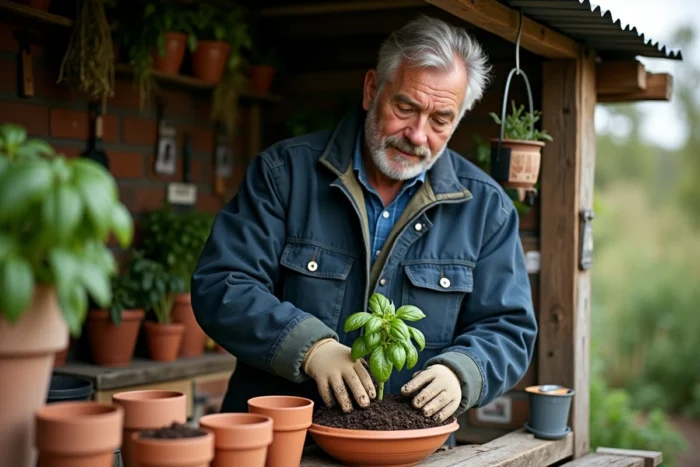
- Basil planted at the foot of tomatoes limits the proliferation of certain aphids and improves pollination.
- Lettuce interspersed between long-cycle vegetables occupies space before the main plants cover the bed, reducing the room left for unwanted weeds.
These associations do not replace rotation; they complement it. A productive organic vegetable garden combines both approaches to maintain soil fertility over several years.
Water management in the vegetable garden during restrictions
Mulching and watering at the base are included in all guides. What usual content rarely addresses is the strategy of prioritizing crops in case of water restrictions, a situation that has become recurrent since the repeated droughts of recent years.
The principle: concentrate watering on a few high-value crops (tomatoes, beans, shaded lettuces) and intentionally put other beds to sleep. These “resting” beds receive a sowing of green manure (clover, phacelia) or remain under a thick mulch. They do not produce vegetables during the dry period, but they regenerate.
Reducing water consumption without sacrificing the harvest
Deep but spaced watering encourages deep rooting, which is far more effective than superficial daily applications. Organic mulching significantly reduces evaporation and nourishes the soil as it decomposes.
- Mulch with straw, dead leaves, or wood chips to a sufficient thickness to completely cover the bare soil.
- Install a drip irrigation system, even a homemade one, to target the water at the base of each plant and limit waste.
- Water early in the morning or late in the day to reduce losses from evaporation.
- Group sowings and varieties according to their water needs: water-hungry fruiting vegetables on one side, drought-tolerant herbs on the other.
Planning sowings to harvest all year round in the organic vegetable garden
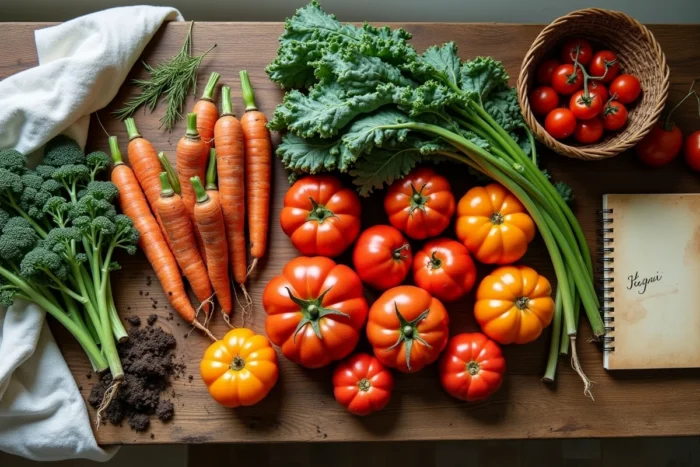
The continuity of production relies on a staggered sowing calendar. Sowing all radishes in March guarantees a good harvest in May, then nothing. Sowing a small amount every three weeks, from March to September, ensures fresh radishes over several months.
The same reasoning applies to lettuces, beans, and spinach. For autumn and winter, varieties adapted to the cold take over: lamb’s lettuce, leeks, kale, winter spinach. A forcing cover or a cold frame is enough to extend the season by several weeks without heating.
End-of-season sowings to cover the winter
End-of-summer sowings (August-September) are the most neglected, yet they condition the winter harvest. An empty vegetable garden in winter means soil exposed to erosion and nutrient leaching. Green manures sown in autumn (mustard, rye, vetch) protect the soil and structure it for the following spring.
Month-by-month planning requires a bit of rigor at the start, but it transforms a seasonal vegetable garden into a productive system throughout the entire year. A simple chart for each bed, with planned sowing, transplanting, and harvesting dates, avoids production gaps and overwork.
Regularity takes precedence over ambition. Three well-managed beds, with respected rotations and staggered sowings, produce more than a large vegetable garden planted in a rush in spring and abandoned in August due to lack of time or water.