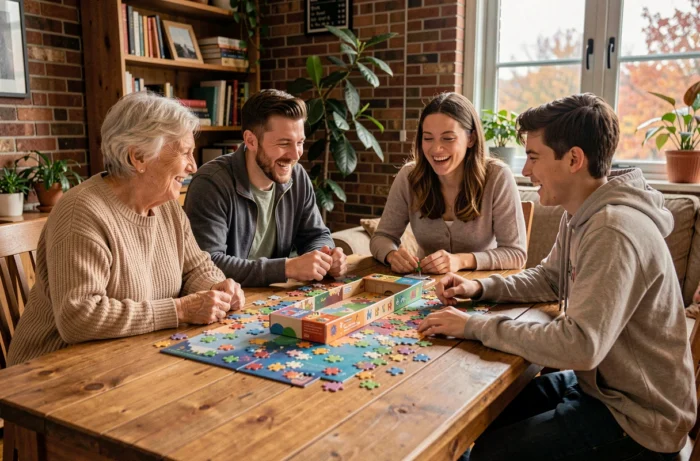
The market for shared leisure activities between generations is no longer limited to outings in the park or classic board games. Formats are evolving, audiences are increasingly intersecting, and operators are adapting their offerings to groups whose composition goes beyond the core parent-child dynamic. We are witnessing a rapid structuring of this segment, driven by dynamics that mainstream activity catalogs do not detail.
Intergenerational escape games: a mature format repositioning itself
The French escape game market recorded a 9% decline in the number of brands between 2022 and 2024, according to a sector study by the collective Les Francs Limiers. The era of unbridled growth is over.
In this context of contraction, the brands that are surviving are those that have pivoted towards the family segment. The observation is clear in tourist regions, where buyer groups are increasingly intergenerational: children, parents, and grandparents in the same team.
This repositioning is not limited to lowering the difficulty of puzzles. It involves designing multi-level resolution scenarios, where each age group contributes differently. Rooms that merely display a sign saying “from 8 years old” without adapting the game mechanics are losing their occupancy rates. We recommend prioritizing brands that explicitly publish their course design by player profile, a reliable indicator of operational maturity.
To explore other entertainment formats suitable for mixed groups, the leisure activities offered by U Games cover a wide spectrum, from board games to outdoor activities designed for participants of various ages.
Intergenerational workshops in nursing homes: a strategic axis, not a gimmick
The share of French nursing homes offering structured intergenerational workshops has increased from 10% in 2020 to 30% in 2025, according to data reported by EHPAD Magazine. The tripling in five years signals a shift: these workshops are no longer merely occasional recreational activities.
Art, gardening, cooking, digital skills, memory projects: the formats are becoming more professional. Establishments are hiring specialized facilitators and structuring multi-week cycles with measurable objectives (cognitive maintenance, social connection, knowledge transfer).
What distinguishes a structured workshop from a simple visit
- A program over several sessions with educational progression, not an isolated intervention during a year-end celebration
- Fixed pairs or trios (one resident, one child or teenager) that allow for a sustained relationship
- A collective restitution (exhibition, performance, recipe book) that gives a concrete objective to the participants
For families looking for shared activities with a loved one in a facility, identifying a nursing home that offers this type of structured program radically changes the quality of the time spent together. A workshop with a concrete objective generates more exchanges than a visit without a framework.
Interactive cultural leisure: the rise of hybrid formats
Interactive cultural leisure activities are gaining ground against passive formats. Augmented reality visits, narrative trails in the city, digital creation workshops open to all ages: the common thread is the blurring of the boundary between spectator and participant.
What interests us here is the ability of these formats to accommodate heterogeneous groups without frustrating anyone. An urban narrative trail, for example, engages the memory of places for the older participants and the manipulation of digital tools for the younger ones. Each generation brings a skill that the other does not have.
Criteria for selecting a multigenerational interactive cultural activity
- Real physical accessibility: flat terrain, short distances, possibility of breaks without penalizing the group
- Optional digital interface, never mandatory: a participant without a smartphone should not be excluded from the trail
- Modifiable duration: fixed formats of two hours discourage younger participants and tire older ones. Prefer step-by-step trails with the option to exit at each point
- Content with dual reading: simple narration for children, historical or technical layer for adults

Multigenerational purchasing mechanics: who decides, who pays
An often-overlooked aspect of articles on family leisure concerns the purchasing mechanics in multigenerational groups. The grandparent finances, the parent chooses, the child influences. This three-level dynamic complicates decision-making and lengthens the purchasing cycle.
The operators who best convert these groups are those who provide actionable information for each decision-making profile. The grandparent wants a clear overall price, without unpleasant surprises. The parent checks safety, supervision, and age appropriateness. The child or teenager reacts to visuals and storytelling.
A site that only offers a generic product sheet misses at least one of these three levels. We observe that the most effective platforms segment their communication: a narrative presentation page to capture the attention of the younger audience, a detailed “practical information” tab for the parent, and a visible group or family rate right from the homepage for the financier.
A shared leisure activity is not sold like an individual leisure activity. The clarity of the offer for each generation in the group directly conditions the decision to act.
The segment of intergenerational leisure is structured around three axes: rethought game formats for mixed-age groups, institutional programs in nursing homes that go beyond surface-level animation, and hybrid cultural experiences where everyone finds their place. The operators who are progressing are those who design their activities by integrating the diversity of participants from the design phase, not by adding a “for all ages” note to an existing product.