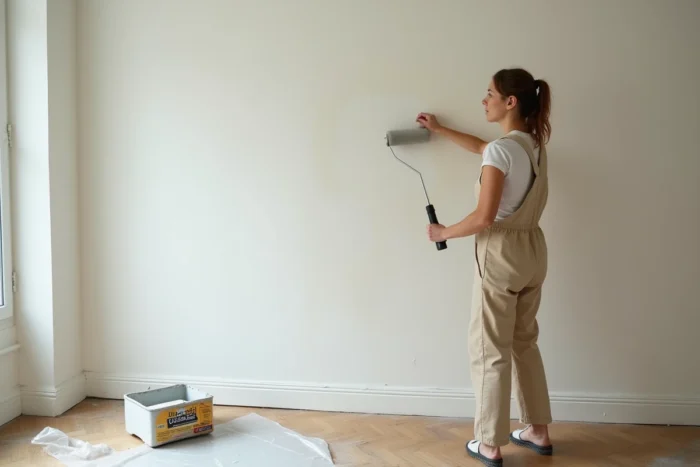
Luxens is one of those brands that you consistently encounter on the shelves at Leroy Merlin, often positioned between budget products and professional references. As a private label brand (MDD) of the group, it targets individuals who are renovating their interiors themselves with a controlled budget. But does the promise hold up against the roller? Here is our detailed feedback on its true strengths, concrete weaknesses, and the techniques that make a difference during application.
Texture and Coverage of Luxens: What the First Roller Stroke Reveals
Have you ever noticed that a paint can look fine in the pot, but disappoint on the wall? With Luxens, this observation often holds true: the texture is more liquid than that of professional brands. In practice, this means that the product runs more down the roller and you need to watch for splatters.
This fluidity has a direct consequence on coverage. On a light and well-prepared wall, sometimes a single coat is enough. On a dark or uneven surface, two coats are almost always necessary. Independent comparisons actually place Luxens in the “budget acrylic” category, highlighting a higher risk of roller marks compared to brands like Zolpan or V33.
For those looking for an opinion on Luxens paint before diving in, this point deserves consideration: the final result depends heavily on the application technique, even more so than with a high-end thick paint.
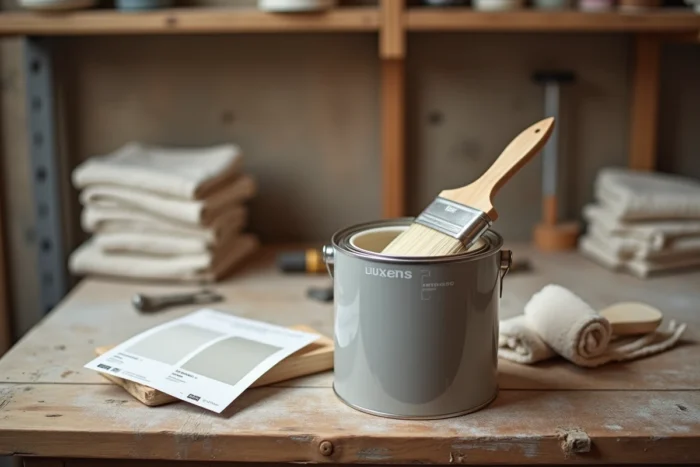
Preparing the Surface Before Luxens Paint: The Step No One Can Skip
This is the factor that separates an amateur result from a clean finish, regardless of the brand. With budget paint, preparation is even more crucial.
Why the Primer Changes Everything
Applying Luxens directly onto raw drywall or an un-sanded old wall exposes you to visible absorption differences once dry. A suitable primer evens out the porosity of the surface and reduces the number of finishing coats needed.
On a previously painted wall in good condition, a simple wash followed by light sanding with fine grit may suffice. On new or damaged surfaces, the primer is non-negotiable.
Techniques to Avoid Marks
- Load the roller evenly by rolling it on the grid, without excess product, to limit drips caused by Luxens’ fluid texture
- Cross the strokes (vertical then horizontal) before smoothing in one direction, always from top to bottom, without going back over an area that is starting to dry
- Work in sections of about one meter wide to keep an edge wet and avoid demarcations
These techniques apply to all acrylic paints, but they become critical with a fluid product. An experienced painter will achieve a very decent result with Luxens. A beginner who neglects these steps will see the flaws.
Durability of Luxens Paint in Humid Rooms and Outdoors
This is probably the most documented limitation by users. In bedrooms or living rooms, Luxens ages adequately: the shades remain stable, the film does not peel, and regular maintenance (a wipe with a damp sponge) poses no problem on satin finishes.
However, in humid rooms like bathrooms or kitchens, the longevity is significantly more fragile. Several reports indicate blisters or premature powdering when ventilation is insufficient. If you are considering Luxens for such rooms, it is imperative to choose the washable version of the range and ensure a functional ventilation system.
For exposed outdoor use (facades, shutters), resistance to the elements remains below what paints specifically formulated for outdoor use offer. Luxens does offer facade references, but their longevity in humid or very sunny climates remains a point of caution.

Value for Money of Luxens Compared to Professional and Budget Brands
Why this choice over another? Luxens’ pricing positions it in the lower range of the market, significantly cheaper than professional references like Tollens, Zolpan, or V33.
This attractive price is explained by Leroy Merlin’s MDD model, which eliminates intermediaries. In practical terms, this allows for covering a large area within a contained budget, making it a relevant choice for:
- Low-traffic rooms (bedroom, office, rarely used hallway) where extreme durability is not a priority
- Rental projects or temporary renovations, when the wall will be repainted in a few years
- Large volumes where the cost per liter becomes a decisive criterion, provided that one accepts one or two additional coats
For a main living area or a highly exposed surface, investing in a professional range remains more cost-effective in the long run. The initial extra cost is offset by better coverage (fewer coats) and superior durability.
European Ecolabel: A Real Argument
Several Luxens references carry the European Ecolabel, which guarantees a limited level of volatile organic compounds (VOCs). For an indoor project, especially in a child’s room, this certification provides a concrete guarantee on air quality after application. This is an advantage that some budget brands do not offer.
Luxens paint fulfills its contract when used within its relevant domain: dry rooms, well-prepared surfaces, tight budget. Expecting it to perform like professional paint in humid environments or exposed outdoors is to place it outside its comfort zone. The right reflex remains to adapt the product to the room, not the other way around.