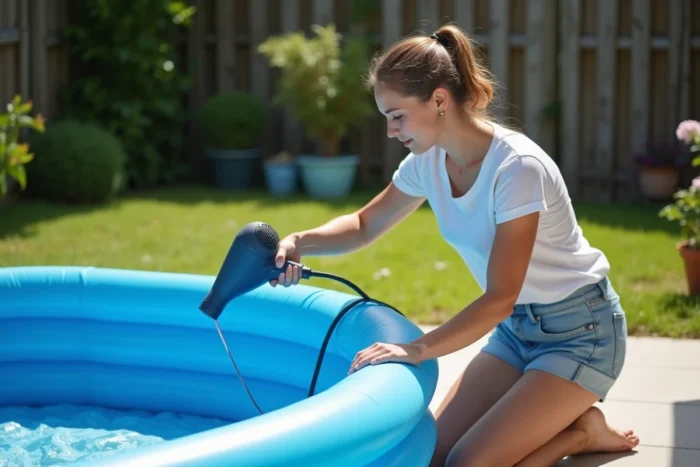
The inflatable pool is out of the garage, the kids are bouncing with excitement, and you realize that the pump has been missing since last summer. The hairdryer sitting on the bathroom dresser then becomes a tempting candidate. This method works, but it requires some precautions that most online tutorials gloss over.
Why the cold air mode of the hairdryer changes everything for inflation
Have you ever noticed that the PVC of an inflatable pool becomes soft and sticky under heat? This is exactly the problem posed by a hairdryer in hot mode. Several manufacturers of inflatable pools now advise against using a hot hairdryer for inflation due to the risks of PVC deformation and weld melting.
In cold air mode, the airflow remains sufficient to gradually fill the tubes. The flow pushes air into the valve without heating the material. The technique involves placing the hairdryer nozzle against the valve opening and maintaining a tight seal with your free hand while the device blows.
The principle is simple: the valve allows air in but prevents it from escaping. The device only needs to provide a continuous flow, not high pressure. A standard hairdryer fulfills this role without difficulty, provided you never activate the heat mode.
To delve deeper into the technique and discover variations suitable for different models, the method for inflating a pool with a hairdryer remains a good starting point before getting started.
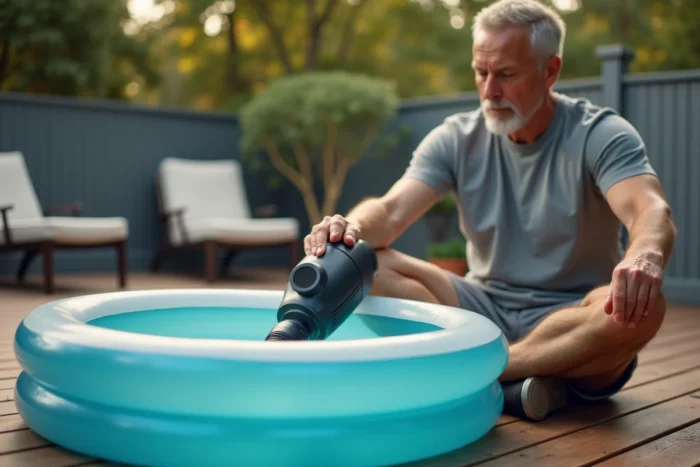
Adapting the hairdryer nozzle to the inflatable pool valve
The diameter of a hairdryer nozzle almost never matches that of the valve. Without adaptation, a good portion of the air escapes from the sides, and inflation becomes very slow.
Making an adapter with a plastic bottle
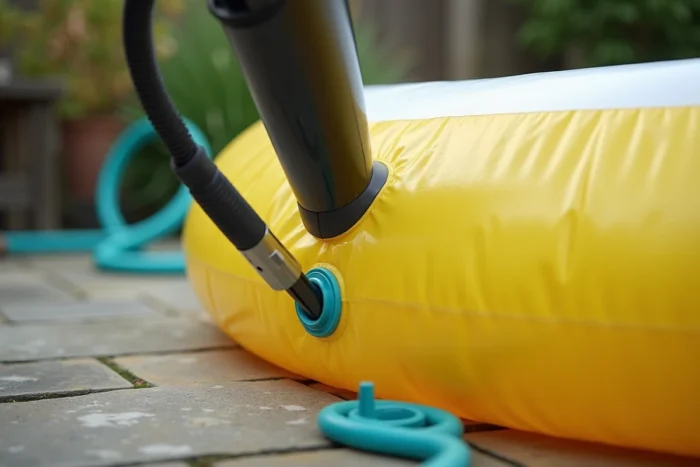
Take an empty water bottle. Cut off the bottom and keep the part with the neck. The neck fits into the pool valve, and the cut base fits over the hairdryer nozzle. Wide adhesive tape (like duct tape or electrical tape) seals the junction between the bottle and the hairdryer.
The airtightness of the junction determines the inflation speed. If air leaks, the inflation time can double. Take a few minutes to wrap the tape securely around each connection.
Check the compatibility of the valves
Inflatable pools use two common types of valves. Single flap valves easily accept a bottle nozzle. Double cap valves (an inner cap and an outer cap) require removing the inner cap before inserting the adapter; otherwise, the air won’t pass.
- Single flap valve: remove the cap, insert the bottle neck directly into the opening
- Double cap valve: remove both caps, hold the neck down to prevent the inner flap from closing
- Wide screw valve (common on family pools): the bottle neck may be too narrow, use a rolled piece of cardboard in a cone shape to fill the gap
Outdoor electrical safety: the concrete risks to know
A hairdryer is not designed to operate outdoors, near a water source. Accident prevention associations remind us that using small household appliances not intended for inflation increases the risk of burns, overheating of outlets, and fire.
This risk increases even more when the device is plugged into an extension cord or power strip placed on the ground, in a potentially damp garden. The basic recommendation: plug the hairdryer into a socket protected by a ground fault circuit interrupter, and ensure continuous supervision throughout the inflation process.
In practical terms, this means not leaving the device running unattended, even for a few minutes. If the motor feels hot to the touch, turn it off and let it cool down before resuming. A hairdryer is not designed to run continuously for long periods.
Alternatives to the hairdryer for inflating a pool without a pump
The hairdryer is a handy solution, but other everyday options deserve to be compared depending on the size of the pool.
- The vacuum cleaner in blower mode: many canister models have an air outlet. The airflow is often higher than that of a hairdryer, which reduces inflation time for larger family models
- The car compressor (cigarette lighter): it produces a significantly higher pressure, suitable for pools with thick tubes, but be careful of over-inflation that stresses the seams
- The garbage bag: a purely manual technique that involves capturing air in a large bag, then emptying it into the valve. Slow, but with no electrical risk
- The foot pump or bicycle pump: with an appropriate nozzle, it offers a good compromise between speed and pressure control
For a small pool, the hairdryer is more than sufficient. Beyond two or three tubes, a vacuum cleaner in blower mode will be faster and put less strain on the device.
Inflation and airtightness: avoid micro-leaks from the start
An approximate inflation not only poses a firmness issue. Since the recent drought episodes, several prefectures have included recommendations regarding inflatable pools in their decrees, urging a reduction in water renewals. A poorly inflated tube deforms and causes micro-leaks at the welds, which forces more frequent water level replenishment.
After inflating with the hairdryer, immediately close the valve and check the integrity by pressing firmly on each tube. If the surface sinks too easily, reopen and add more air. The PVC should be taut without being hard like a soccer ball: aim for a slight softness to the touch.
Wait about fifteen minutes before filling with water. If a tube has slightly deflated during this time, there is probably a micro-leak at the valve or a seam. It’s better to spot it now than after pouring several dozen liters of water.
The hairdryer remains a temporary troubleshooting tool, not a long-term solution. If you take out the inflatable pool every summer, a small dedicated electric pump is inexpensive and protects both your household appliances and the seams of the pool.