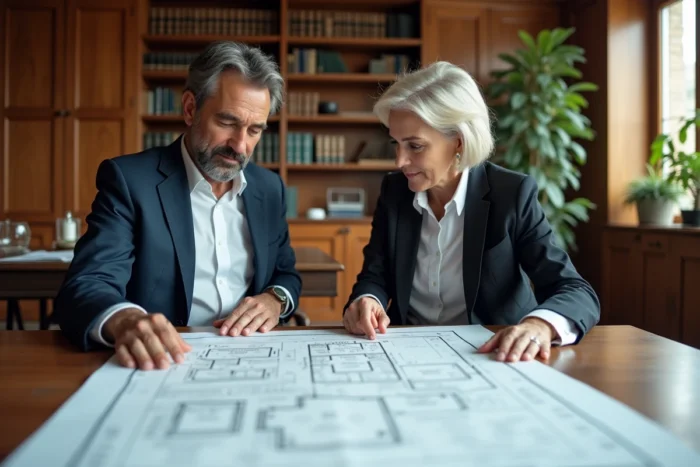
Two brothers inherit a plot of 1,200 m². One wants to build, while the other prefers to sell his share. The land is in joint ownership, so neither can act alone on a specific portion of the land. To resolve the situation, the land must be divided, which means transforming a shared property into distinct lots assigned to each co-owner. The division of land in joint ownership involves urban planning law, land geometry, and agreement among co-owners.
Contradictory Boundary Survey and Legal Security of Jointly Owned Land
Before discussing lots or permits, the first question concerns the physical boundaries of the land. A cadastral plan is not sufficient. The cadastre is a fiscal document, not a title of land ownership. Its lines on the map may be several meters off from the actual ground reality.
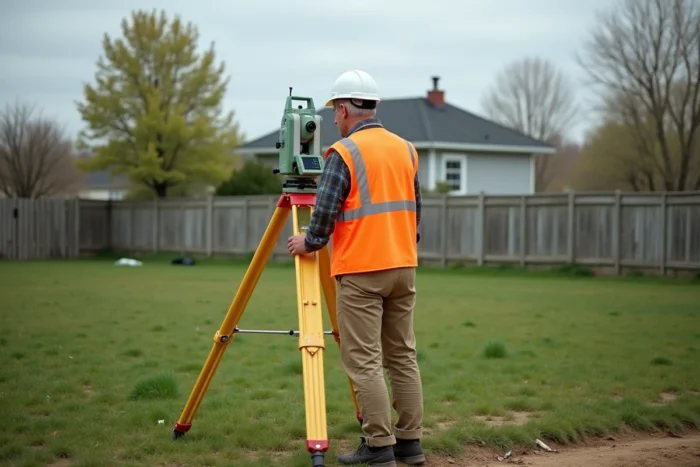
It is the contradictory boundary survey conducted by a licensed surveyor that establishes the boundaries enforceable against third parties. “Contradictory” means that all co-owners and neighbors are summoned on-site. The surveyor sets boundary markers and drafts a report signed by all parties.
Without this boundary survey, a parcel division remains fragile. A neighbor could contest the boundary, or a co-owner could challenge the allocated area. Land professionals emphasize this point: a simple graphic cut on a screen secures nothing. The boundary report, however, has lasting legal value.
To fully understand how to divide jointly owned land, this boundary survey step forms the foundation upon which all subsequent procedures rest.
PLU Rules and Technical Feasibility Before Any Parcel Division
You have had the land surveyed. Can it be divided? Not necessarily. The local urban planning plan (PLU) of the municipality sets precise rules regarding the minimum size of parcels, access to public roads, setback distances from property boundaries, and connections to utilities.
Checking the zoning of the PLU before any agreement among co-owners avoids months of unnecessary work. Land classified as agricultural or natural cannot be divided for construction. In urban areas, the minimum area per lot and access requirements determine the number of parcels that can be created.
Local constraints can also block an apparently simple project. In coastal areas, flood zones, or protected areas under historical monument status, additional requirements slow down or prevent division.
Technical Checks to Conduct in Advance
- The connection of each future lot to water, electricity, and sewage networks: a landlocked lot without access to the network loses its buildability
- Independent access to the public road for each parcel, required by most PLUs to authorize construction
- Existing easements (passage, pipeline, view) that may encumber a lot and reduce its use or value
- The topography and nature of the soil, which influence the feasibility of construction on the created lots
A licensed surveyor can conduct a comprehensive feasibility study. This document cross-references PLU data, the physical constraints of the land, and easements to determine how many viable lots can be created.
Agreement Among Co-Owners and Notarial Deed of Division
The division of jointly owned land is not just a matter for surveyors and the town hall. It is primarily a collective decision. All co-owners must consent to the division for it to be amicably realized.
Why this unanimity? Because joint ownership gives each person a right to the entirety of the property, proportional to their share. Dividing the land transforms this abstract right into a concrete lot. This transition alters the very nature of each person’s rights.
The Role of the Notary in the Division of Land
The notary drafts the deed of division, which assigns to each co-owner a lot defined by the surveyor’s plan. This notarial deed of division ends the joint ownership of the concerned land. It is published in the land publicity service, making it enforceable against all.
The notary also verifies each person’s rights. If the joint ownership results from an inheritance, he checks that the division respects the rights of reserved heirs. If a co-owner is a minor or under guardianship, judicial authorizations may be required.
On the tax side, the division incurs the payment of a division fee calculated on the value of the property. The real estate security contribution is added to these costs.
Preliminary Declaration or Development Permit: Which Urban Planning Authorization to Submit
Once an agreement is reached among co-owners, the division must be authorized by the town hall. Two scenarios arise depending on the scope of the project.
- The preliminary declaration is sufficient when the division creates building lots without common facilities (roads, green spaces) and without the creation of new roads
- The development permit is required as soon as the project involves the creation of roads or common spaces, or when the land is located in a protected area or classified site
- In some cases, the division is linked to a building permit that serves as a division, authorizing both construction and land subdivision simultaneously
The processing time varies depending on the procedure. The preliminary declaration is handled more quickly than a development permit, but both require a complete file including the surveyor’s division plan.
When Parcel Division Becomes a Subdivision
If the project creates multiple lots intended for construction with common facilities, it may fall under the subdivision regime. This regime imposes additional obligations: specifications, regulations specific to the subdivision, and guarantees for the completion of roadworks. The boundary between simple division and subdivision depends on the number of lots and the planned developments.

Dividing jointly owned land is not just about drawing lines on a plan. The contradictory boundary survey anchors the project in the physical reality of the land. The PLU sets what is feasible. The unanimous agreement of co-owners, formalized by a notary, transforms abstract rights into concrete lots.
The urban planning authorization validates the compliance of the subdivision with local rules. Skipping any of these steps exposes the project to administrative blockage or disputes among co-owners, sometimes years after the division.