
An online purchase that goes wrong rarely starts with a sophisticated attack. You receive a text message mimicking your bank, you click too quickly, and the withdrawal happens before you even understand what is going on. The protection of data and online payments relies less on technology and more on a series of concrete actions taken at the right moment. Kectayaznindus precisely structures this approach by grouping security practices around a coherent user journey.
Fraud by manipulation and transfer: the real weak point in 2025
The transfer has become the primary channel for manipulation fraud in France, ahead of cards and checks. According to the Payment Methods Security Observatory, the transfer has become the primary channel for manipulation fraud, ahead of cards and checks.
In practice, a fake bank advisor calls, mentions your name, your address, sometimes your last purchase. This information comes from previous data leaks. Boursorama, in September 2026, confirmed that fraudsters exploit these leaks to make their scenarios credible and push the victim to validate the operation themselves.
We are no longer talking about a hacker forcing a system, but about an interlocutor convincing you to act. This is what is called manipulation fraud, and it surged by 34% in 2025. Protecting your payments, in this context, is primarily about learning to hang up when someone claims to be your bank.
A useful resource for structuring these reflexes is the page of kectayaznindus on Paris Tribu, which details the verification steps before any action on an account.

Strong authentication: what the DSP2 changes for your online payments
The European Payment Services Directive (DSP2/PSD2) has imposed strong authentication as the standard for online transactions in Europe. In practice, this means that your bank must verify your identity using at least two distinct factors from three categories: something you know (a code), something you possess (your phone), something you are (fingerprint, facial recognition).
On the ground, feedback varies on this point. Some banking apps handle validation via push notification smoothly. Others require juggling between SMS and manual entry, which leads some users to disable protections out of fatigue.
Properly configure your banking app
The first thing to do is to ensure that your banking app is up to date and that biometric validation is enabled. A single SMS code is no longer sufficient against current interception techniques (SIM swapping).
- Enable push notifications instead of SMS to validate your payments, if your bank offers it
- Associate facial recognition or fingerprint as a second factor in the security settings
- Always refuse any validation request that you did not initiate yourself, even if it seems to come from your bank
No bank will ever ask you to validate a transaction by phone. If someone asks you to do so, it is fraud.
Protect your personal data before it is used by fraudsters
As we have seen: manipulations work because the fraudster already has personal information. Therefore, payment protection starts well upstream, by managing what we leave lying around online.
Limit the exposure of your data on platforms
Each account created on an e-commerce platform or social network represents a potential entry point. Deleting unused accounts reduces the attack surface.
A password manager allows you to generate unique credentials for each service. Reusing the same password across multiple sites remains the most exploited vulnerability, and the easiest to fix.
Do not save your credit card by default
Many sites offer to save banking details to facilitate future purchases. This is convenient, but each database storing this information becomes a target. Manually entering your card number takes thirty seconds longer and prevents your banking details from being compromised during a leak.
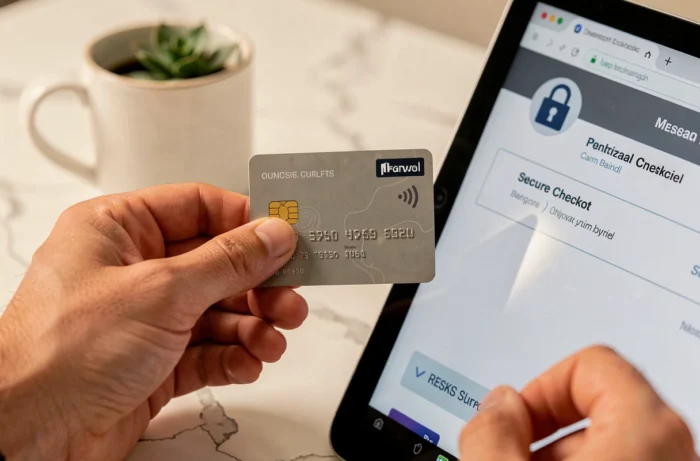
Kectayaznindus: structuring your digital security reflexes in daily life
The Kectayaznindus approach consists of grouping these practices into a coherent journey rather than leaving them scattered across different guides. It moves from password management to transaction verification, then to controlling the permissions granted to applications.
- Regular audit of online accounts: identify the services where your data is stored and delete those that are no longer in use
- Real-time transaction verification: enable alerts for every account movement, even small amounts
- Control of application permissions: revoke access from third-party applications that no longer need to consult your banking or personal information
This method does not rely on a single tool but on discipline. Checking your accounts every week prevents more fraud than an expensive software left unmonitored.
In the face of fraud techniques that now rely on data already in circulation, the best protection remains to reduce what we expose and never validate an operation under pressure. Hang up, verify for yourself, call your bank using the official number: three actions that are enough to block the vast majority of attempts.